Linked public law cases highlight welfare-first approach in family court
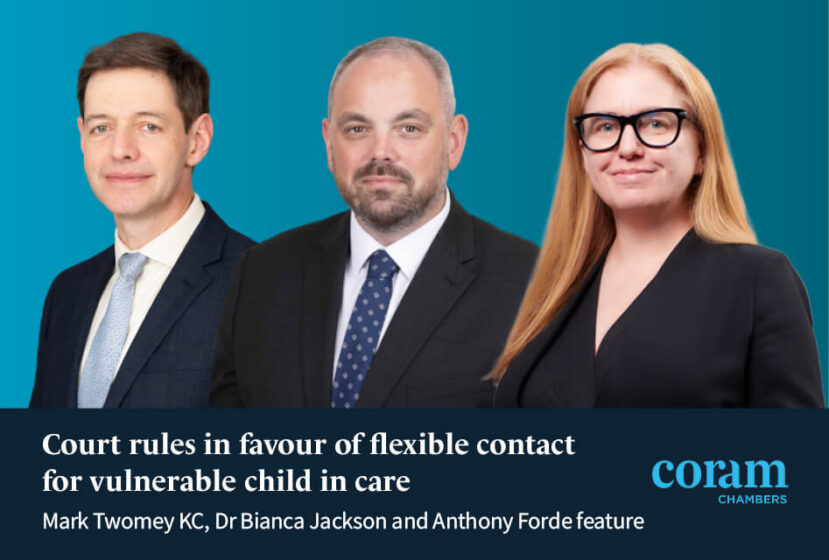
A series of recently published public law cases has put the child’s welfare at the heart of contact arrangements, reinforcing key principles in family law. Barristers from Coram Chambers, namely Mark Twomey KC, Dr Bianca Jackson, and Anthony Forde, acted in these important cases, which were initially heard in 2021 and 2022 but only reported now due to related criminal proceedings.
Background to the cases
The proceedings were initiated due to concerns that the mother had caused deliberate harm to her youngest child, A. Mark Twomey KC, leading Dr Bianca Jackson, acted for the local authority in the initial fact-finding and final hearing, and was successful in seeking findings against the mother.
A was placed in long-term foster care under a final care order and her older sisters remained with their father. The judgments can be found on the National Archives website, and at the bottom of this page, providing detailed insight into the court’s reasoning.
Key facts of the final case
In the most recent case, the court considered an application under section 34 of the Children Act. Subsequent to the fact-finding and final hearing detailed above, the mother was convicted of cruelty towards A. After release from prison, she sought to increase direct contact with A. This was opposed by the local authority, who was represented by Anthony Forde, and the children’s guardian proposed a minimum of four supervised visits each year.
The Judge examined the evidence closely. A, who has complex disabilities, had improved emotionally and behaviourally with a stable care arrangement and reduced contact. Past frequent contact had caused distress and threatened her foster placement. The mother’s lack of insight and unrealistic expectations further undermined her case.
What the court decided
The court found that the child’s welfare must remain the paramount consideration. Imposing a fixed, frequent contact order would risk harm and disrupt progress. Instead, the judge endorsed a flexible, professionally managed contact plan. The local authority will ensure A has at least four supervised visits with her mother every year, with scope for review as circumstances change.
Significance for public law
These linked cases reinforce the principle that a child’s best interests outweigh parental rights, especially where there is a history of abuse and ongoing vulnerability. The family court’s reluctance to impose rigid contact orders in long-term care reflects a modern, child-centred approach.
For further details, the judgments are available at:
- London Borough of Bexley v M & Ors (No 1) Neutral Citation Number[2021] EWFC 131 (B)
- London Borough of Bexley v M & Ors (No 2) Neutral Citation Number[2022] EWFC 220 (B)
- M v LBB (No 3) Neutral Citation Number[2026] EWFC 76 (B)
Barristers involved: Mark Twomey KC, Dr Bianca Jackson, Anthony Forde (all of Coram Chambers).