Family law community gathers for IWD 2026
Colleagues from across the family law sector gathered at Coram Chambers to mark International Women’s Day 2026. The event, which drew a full house, centred on this year’s theme: ‘Give to Gain’. This concept aims to encourage generosity, collaboration and support to help create more opportunities for women.
Recognising the impact of women
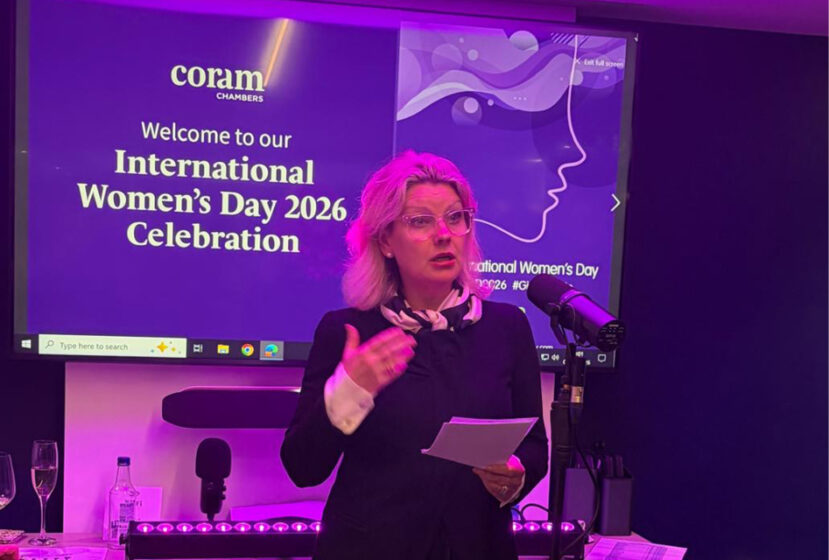
Women shape families, communities, workplaces and public life. Their leadership, resilience and dedication help every part of society thrive. Coram Chambers’ Co-Head, Alison Easton KC, opened the evening with a powerful speech. Alison recognised the importance and effect of giving time and support to lift others as they rise.
A bold challenge to tradition
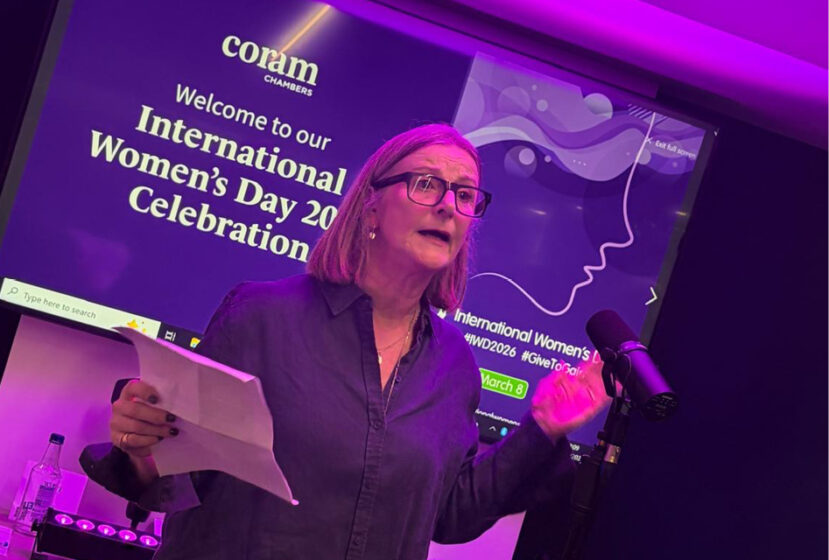
The keynote address, delivered by Her Honour Judge Carol Atkinson, Designated Family Judge for East London, brought the theme into sharp focus with compelling observations. Her speech is shared in full below:
‘Give To Gain’. Really?
Speech given by HHJ Carol Atkinson, Designated Family Judge for East London at Coram Chambers’ IWD 2026 event
It is a privilege to be asked to speak at International Women’s Day (IWD) – especially here at Coram Chambers. To address a room full of so many women that I truly admire is very humbling. On the subject of admiration, I turn to Alison Easton KC – a woman who has scaled the heights despite being my pupil!
For me, International Women’s Day exists not just to celebrate women’s achievements, but to acknowledge the systemic barriers we continue to face and take action to change them.
Victoria Roberts – who never leaves these things to chance – made sure that I was aware that the theme of this year’s IWD is ‘Give To Gain’. She was also clear that I need to be inspirational. No pressure then!
The IWD 2026 theme – Give To Gain – is about harnessing the power of reciprocity and support. Many organisations have taken it up with gusto, their websites packed with advice on how we, us, WOMEN, can give time, give support, give mentorship, give knowledge, experience. Give, give, give. ‘Deeds not words’ is the advice. A commendable call to arms because, as we are told ‘when women thrive we all rise’. To use an aphorism beloved of economists – ‘a rising tide lifts all boats’.
The IWD website, with its lively purple colour theme, displays posters depicting mostly women (I think I have seen one man) in the ‘Give to Gain’ pose. Behold, the giver. There are two poses, in fact. One with both arms outstretched, palms up. Uncomfortably close to the begging pose of Oliver Twist – without the bowl. The other is the one-handed version – one hand outstretched and the other hand on heart. Of course.
Truly, I am a fan of giving. I am, after all, a 63-year-old woman and a mother. I have enjoyed a lifetime of giving. But haven’t women ALWAYS been the designated givers? Not just at home but at work too. And now the way to gain the equality we deserve is to give more? Really? Sorry, but I don’t think so. Was this slogan thought up by a man?
In an article in Campaign, the writer [Charu Srivastava] argued that it is time that our endless giving actually delivered real authority and access. I am inclined to agree.
At home we are the caregivers, the selfless nurturers. In the workplace we give our time to mentoring others, we give our ‘emotional labour’ to build and maintain team morale, we give our energy to diversity, we share our knowledge and experiences. Some are persuaded that if we give enough, we will eventually gain a seat at the high table, but experience suggests otherwise. The giving that women are expected to do has been described elsewhere as ‘workplace housework’. Of course it is important; invaluable even. But it is rarely the benchmark for promotion or advancement.
Conversely, when we look at how men give, the currency they use is political capital. What they give is access. Because they have it. They open doors. Because they have the keys. This is the power imbalance and the essential context within which we are being asked to GIVE to GAIN.
I am not saying that there is nothing for us in GIVING. To be clear there is a lot of good in giving selflessly and without real reward. Irrespective of gender, we should all be doing it. But when we are aiming at systemic change, as we must, doesn’t this simple ‘Give to Gain’ message gloss over that critical power imbalance? The truth is that women are giving from a position of deficit. The power brokers do not recognise the value of that ‘giving’. Consequently, giving more will not change the systems that control and deliver the ‘gain’. In short, we will continue to reap the emotional benefits of selfless giving but we will not be rewarded with equal pay, equal access, equal status.
Returning to the rising tide aphorism, my point is that when the tide rises, unless and until the power balance shifts, we will remain in the sea, at best treading water. We won’t be steering the boat. I am not sure we will even be in the boat.
To those who doubt me, can we pause to consider what it means to be a woman in 2026?
EPSTEIN. Do I need to explain the power imbalance there? Do you think that this scandalous abuse and commodification of women was out of the ordinary? A rarity? Only possible for multi-millionaires and their friends?
Giselle PELICOT – let me apologise for saying her name in the same breath. A very ordinary woman, according to her, drugged and raped by her husband and offered to over 50 men. Still an outlier? A group of men in this country are accused of the same.
How about the day-to-day trials of ordinary women. A woman barged out of the way in the street by the man who is simply irritated by her presence [Lucy Pasha-Robinson, The Guardian Tuesday 17th Feb 2026]. Letters in response suggest this is a common experience of many women. Are these men the adult version of the boy in ‘Adolescence’? How about the many young women normalising their lived experiences of abuse and exploitation; unsurprised by their lack of status and power. [Raye – ‘It’s Hard Out Here’, ‘Ice Cream Man’, ‘Escapism’]. We all have similar stories to tell.
To return to that rising tide – there are times when I worry that we are not even treading water. Maybe we are ‘not waving but drowning’ [Stevie Smith].
But, no, I will not allow myself to believe that. We have been in the water a long time. We are united. We hold up those who are tiring and can’t go on. Hell, we are good swimmers. Together we survive, but we deserve more.
I challenge you all to take a long hard look at yourself and your own organisations. I beg you – DO NOT strike up the ‘give to gain’ pose. Keep on giving as you always have, but do so understanding that it will not get you the reward of equality. More importantly, you need your hands free because we are coming over the side. It’s time for us to get in the boat.
Women can no longer be expected to be the only givers if they are to gain. Those who have power: men, institutions, systems – must start GIVING to US if we are to GAIN true equality.
Institutions must search within themselves and ensure that they are giving so that women can gain. This means providing transparency in pay, establishing equitable pathways that crucially do not penalise or fail to reward caregiving. We need to foster a culture where office housework, as I have described it, marks someone out as worthy of advancement. The giving that women do is often recognised as crucial to the success of many organisations. So, start rewarding women for it. Those skills need to be represented and visible at the top of the organisation. We need leaders with the business and emotional intelligence to see that. We need to be led by more women.
Women do not generally shout loudest, but remember that some women are culturally conditioned to silence or humility. Leaders need to develop the cultural intelligence to recognise talent that does not shout, and to offer support proactively.
This is no more than a start. Real “giving” from leadership requires the targeted and intentional transfer of power. The giving of political capital, active sponsorship and access. Yielding a seat at the table and not just a space for the note taker. It must be an equal seat. Indeed, there should be more than one equal seat. We cannot expect women to lift each other up when the organisation only allows one of us to join the men at the top. Organisations must widen the table.
Finally, women must give themselves permission to stop trying to fix the system without recognition and compensation. ‘Let’s ensure that our generosity is an investment, not a tax. Only then will we truly gain.’ [Charu Srivastava – 03/02/26]
‘No more Miss Nice Lady’ [Atkinson, IWD 2026]